The arancino
with a point
In eastern Sicily the tavola calda is not street food for tourists: it is the labourer's breakfast, the office worker's quick lunch, the tray carried home on a Sunday morning. Arancini, pizzette and cartocciate sit behind the glass of every bar, and are bought by the piece.
This morning is spent on the other side of the counter, in the kitchen with Signora Nella. You learn the three things that have always filled that tray — and the star is the arancino.
Two and a half hours, hands in the rice and in the dough, and at the end you eat everything you have made.
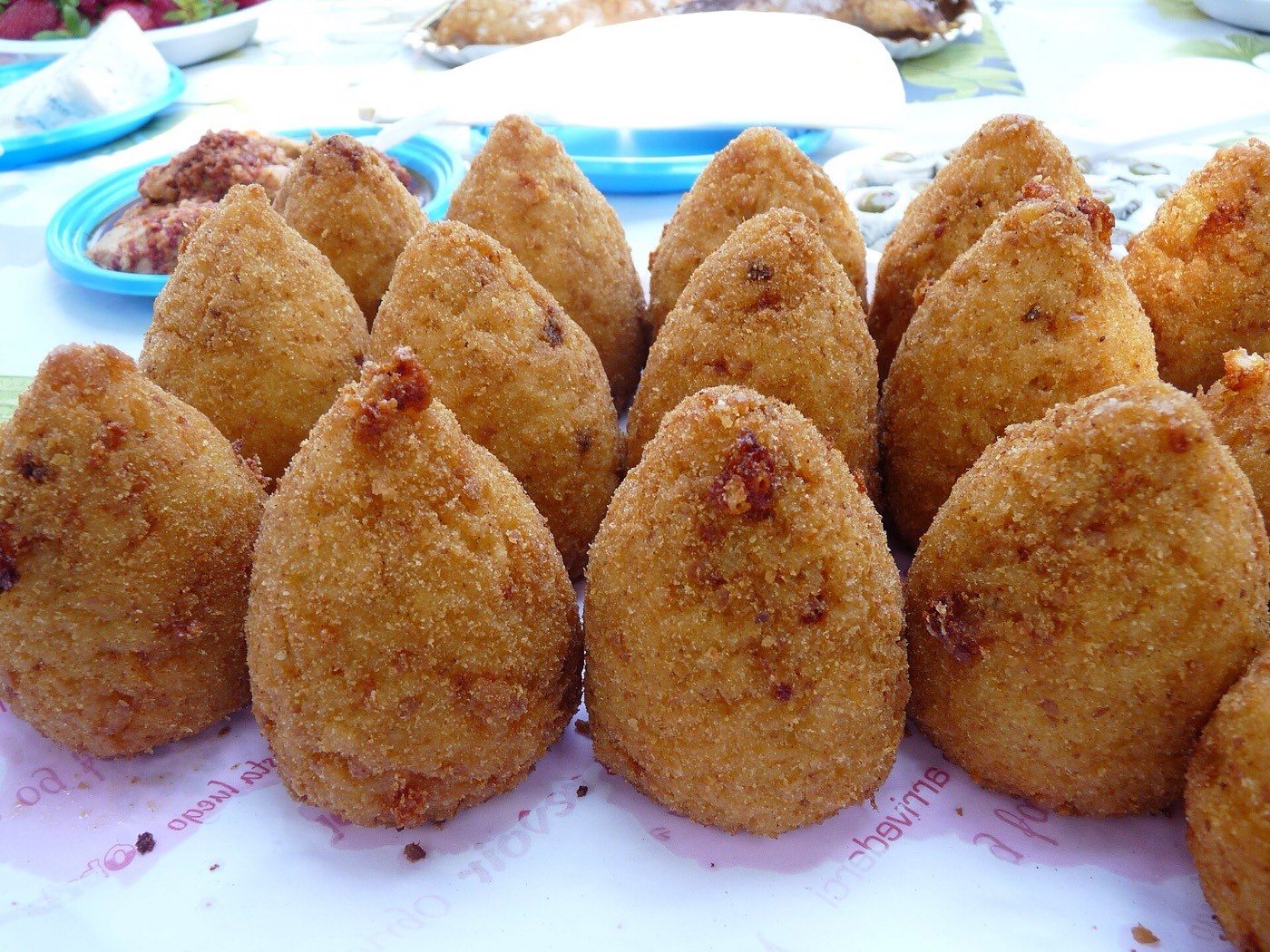
The cone shape of eastern Sicily — archive photograph by Ji-Elle, CC BY-SA 3.0
In Catania the arancino has a point
The difference shows before you taste it. In eastern Sicily the arancino is shaped into a cone, point upwards; in Palermo it is round and called arancina, in the feminine. As for the reason for that point, the explanations chase each other — some say Etna, some say convenience — and none is really proven.
What is certain is that the shape changes the making: the cone closes in the hand, layer after layer, and holds the ragù at the centre without letting it escape. It is a gesture, and like every gesture it is learnt by doing it.
Behind the glass of every bar, always
6 moments, 2 hours 30
- 1
Nella's welcome
Nella welcomes her guests into the kitchen and explains what the tavola calda means in everyday life here. Then she introduces the morning's three preparations and the ingredients for each.
- 2
The arancini, one by one
You start with the rice: a portion in the hand, opened at the centre, the ragù goes in and it closes again. Then the shape — the cone, point upwards — which Nella demonstrates once and you then repeat on your own, until it comes right.
- 3
The batter and the breadcrumbs
The coating according to Nella's recipe: first the batter, then the breadcrumbs, pressed so they stick everywhere. That is what will hold everything together in the fryer.
- 4
The cartocciate
On to the risen dough: portioned and rolled out. In go ham, cheese and tomato, then it is closed — and this is where the hand matters. The edges must be sealed properly, one by one, or in the oven the cartocciata opens and loses everything.
- 5
The pizzette
Same dough, different thing: the base is rolled out, dressed with tomato, the cheese added following Nella's recipe. Into the tin, ready for the oven.
- 6
The frying, the oven, the table
Nella runs the frying of the arancini and the baking. You watch closely, you learn what to watch for, and then you sit down: you taste everything you have made, while it is still hot.
You never look at the bar tray the same way again
Three recipes you can make again, and one gesture — the cone — that the hands remember better than the head.
And the next time you pass a rosticceria, you know what is behind the counter: someone who has been closing those cones one by one since dawn.
Tasted while they are still hot
Nella
The tavola calda · Augusta